
.png)
Back to School Bedtime Routine: Fixing Sleep and Screens
Updated: Aug 21
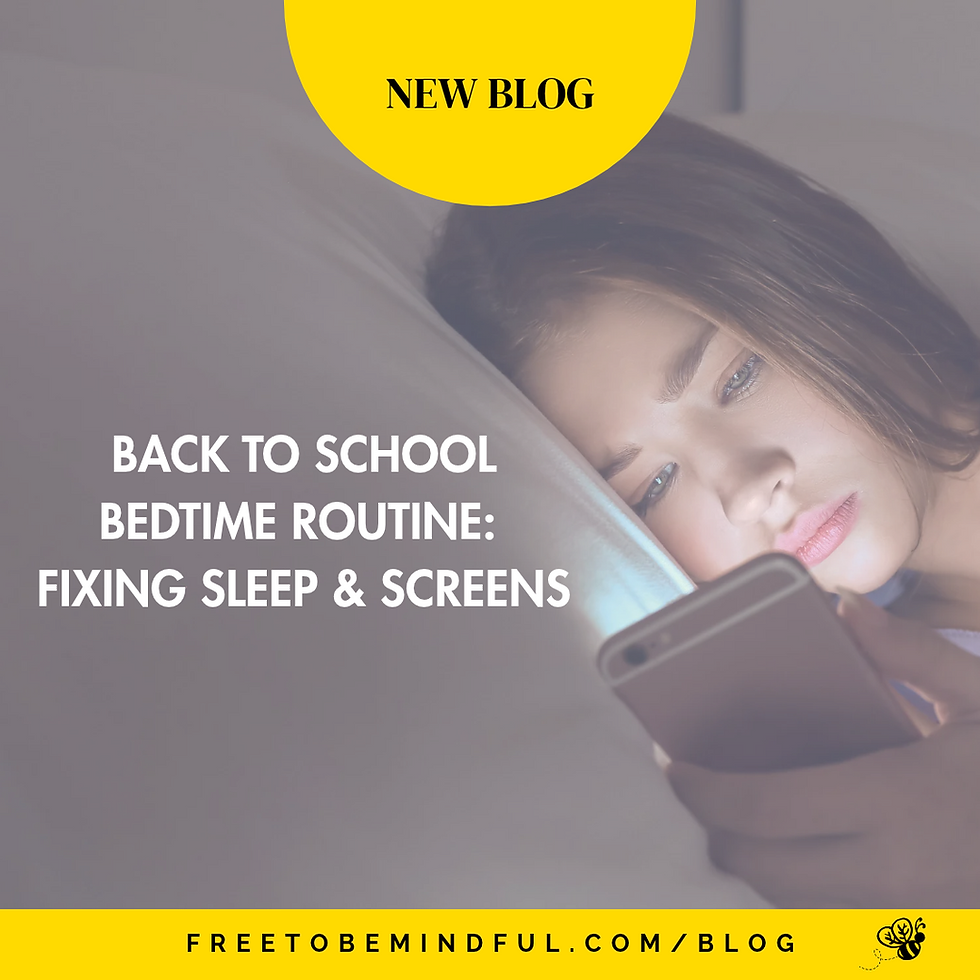
Every August, I have some version of the same conversation in session. I tell a tween or teen client why moving their bedtime back this week is a good idea, and the response is almost always immediate, [insert whiny voice] "Why does it even matter if school doesn't start for three weeks?!?" It's a fair question, and it's the one that trips up most families in this phase of the back to school routine runway.
If you missed part one, the short version is this: we want to shift things gradually before day one instead of changing everything overnight, because becoming a whole new family at 6AM on the first day of school doesn't typically work in anyone's house.
This isn't really about bedtime at all. It's about giving the body time to catch up. Falling asleep earlier and putting a screen down are both skills that need practice and guidance long before they work perfectly, something that's probably true for plenty of adults too, though today the focus is on kids.
The Back to School Bedtime Routine That Actually Works
Sleep and screens are where most of the nightly conflict happens in a household this time of year. After 20+ years working with kids and families, they're consistently the two biggest pain points I hear about.
Key Takeaways:
How to shift bedtime gradually by age, without the fight that comes from changing everything overnight
Why the screen cutoff matters more than the screen rule itself, and how to set it up on iPhone and Android
The one non-negotiable that matters most at night, no matter what age is in the house
Sleep
Moving a bedtime from midnight to nine at night in a few days isn't realistic, our bodies absolutely need time to adjust. The better approach is to move bedtime back in small pieces, about ten minutes earlier every few nights instead of an hour or two all at once.
What that actually looks like depends on the age in the house.
For elementary age kids, aim for lights out somewhere around 8-9PM.
For a tween or middle schooler, closer to 9-10PM.
For a teenager, closer to 10-11PM since their body clock naturally shifts later. It's not realistic to expect the same bedtime you'd set for a younger sibling.
A predictable routine before bed helps too. Dimming the lights, a shower, a few pages of a book, and a parent check-in all signal to the body that it's time to wind down, whether it's a regular bedtime or a night when a game ran late.
Screens
Shifting screen routines and permissions at the same time as bedtime makes the whole process easier. Prying yourself away from the glow of a screen is its own skill, one that takes a few nights to build.
Both iPhone and Android have built-in settings that limit how much time a child spends on each app, what they can access, and during what hours. It's worth the ten minutes it takes to set them up.
Screens go beyond the phone too. Tablets, the Switch, PlayStation, and the TV playing in the background all count, and they're not all equal. An interactive screen, gaming especially, followed by scrolling, wakes the brain up more than a passive one like watching a show. If only one thing can change first, make it whatever's the most interactive in the house.
If there's one non-negotiable in all of this, it's this: no electronic devices in kids' rooms, especially at night. Small moves now save the meltdowns and headaches later, for everyone in the house.
This is the second in a three part series walking through the whole runway. Next week closes it out with the sequence that carries a family through the whole day, after school, the evening, and the morning that follows, so by the time day one arrives, none of it feels new.
FAQs
How far ahead of school starting should I begin shifting bedtime?
About three weeks out is usually enough room to make gradual changes without it feeling like punishment, the same runway timeline used throughout this series.
What if my child won't give up their phone at bedtime?
Start with the cutoff time, not the takeaway itself. Moving the cutoff ten or fifteen minutes earlier each night, and keeping the device out of the bedroom overnight, tends to work better than an abrupt removal.
Is it normal for teenagers to stay up later than younger siblings?
Yes. A teenager's body clock naturally shifts later, so expecting the same bedtime across every age in the house usually backfires.
Which screen time settings should I actually turn on first?
App-specific time limits and downtime hours make the biggest difference. Both iPhone and Android have these built in, and they take about ten minutes to set up.
Vanessa De Jesus Guzman, LPC, NCC is a licensed therapist, CEO of Free to Be Mindful, speaker, and host of the Free to Be Mindful Podcast, named the #1 Latino Mental Health Podcast in 2026 by Feedspot with 300+ episodes. She is also the founder of Amiga Moms™, private coaching for the Mom CEO centered on bringing the same excellence to herself that she already gives everywhere else.
At the core of Vanessa's work is one belief: the people who give everything to everyone else deserve to stop surviving and start living intentionally.
Vanessa is a first gen, bilingual mom of two, and brings 20+ years of experience to the kids, teens and families she works with. She's been voted one of New Jersey's Favorite Kids' Docs, and has been featured on the Today Show, Univision, Parents, and other national publications.


